Category: Buying Guides

  • What Drives the Cost of Custom Banker Bags? A Quote Guide for Firms

    What Drives the Cost of Custom Banker Bags? A Quote Guide for Firms

    Published October 5, 2026. Last updated October 5, 2026.

    The cost of custom banker bags comes down to five choices: the material, the decoration method, the closure and construction, how much personalization each bag carries, and the quantity you order. Custom Banker Bags quotes every order individually from a minimum of 12, so knowing which of these levers matter most helps your firm get an accurate number on the first request.
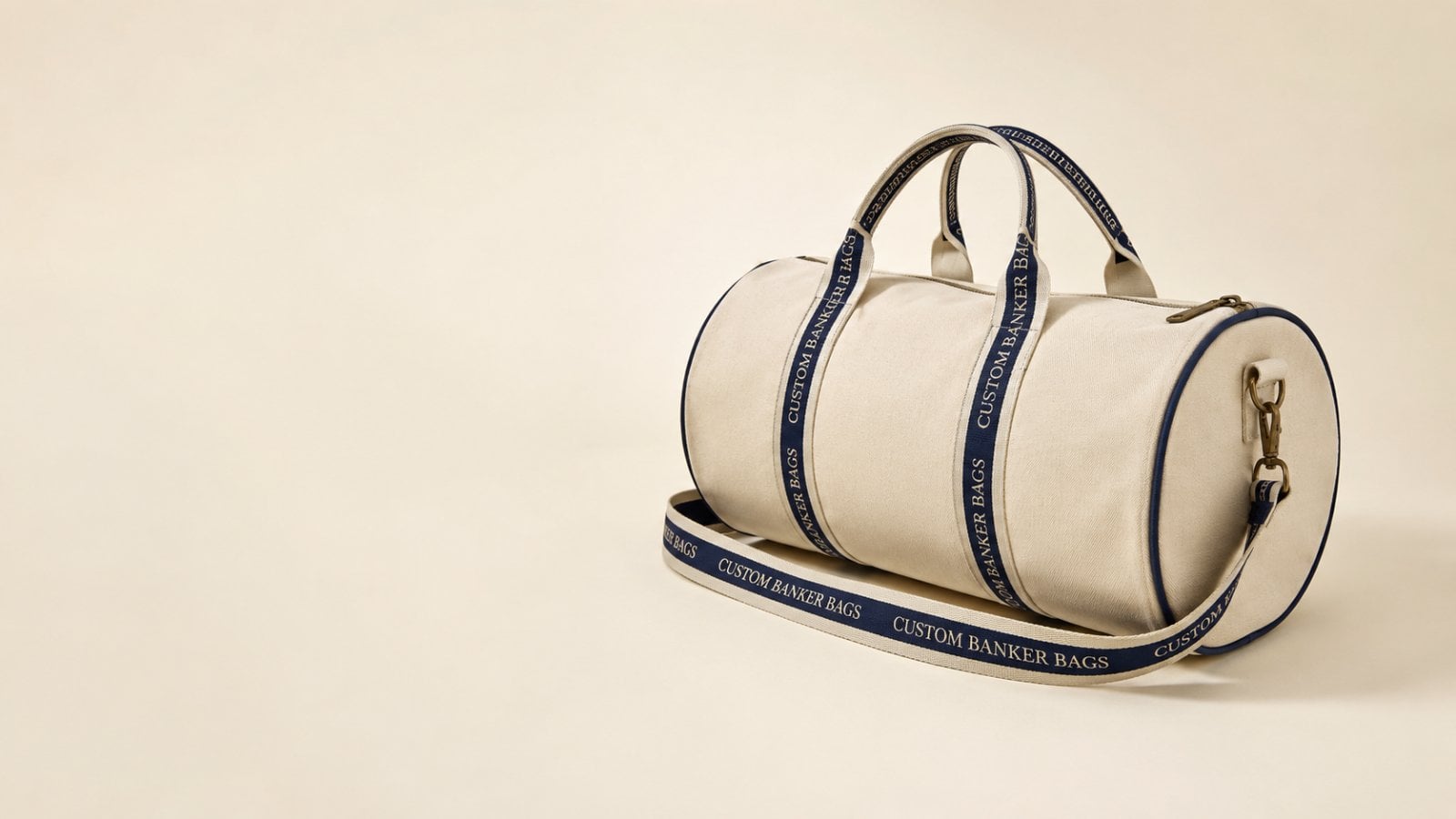
    What Drives the Cost of Custom Banker Bags? A Quote Guide for Firms - custom printed banker bags from Custom Banker Bags
    Custom banker bags with a logo, produced by Custom Banker Bags.
    Key facts
    • Material is usually the biggest single driver: canvas, velvet, suede and leather sit at very different levels.
    • Embroidery is quoted by stitch coverage and placement; a deal name and date on every bag adds setup work.
    • Minimum order is 12 bags, and larger runs spread setup across more units.
    • Every quote includes a free mockup within 24 hours and nothing is owed until you approve the design.
    • Standard turnaround is about 2 weeks, with faster options available.

    What determines the price of custom banker bags?

    The price of custom banker bags is set by five variables working together: material, decoration, construction, personalization and quantity. No single line on a quote tells the whole story, which is why Custom Banker Bags prices each order from the specification rather than from a fixed list. Two firms ordering the same number of bags can receive very different quotes because one chose embroidered canvas and the other chose personalized leather.

    For most finance, legal and real estate buyers, the order of impact looks like this: the material you pick moves the quote the most, the decoration and personalization come next, and quantity determines how setup costs are spread. Construction details such as zippers, linings and gussets fine-tune the result.

    The practical takeaway is simple. Decide which variables matter to your audience before you ask for pricing. A closing gift for a homebuyer, a deal memento for a private equity team and a conference handout for hundreds of attendees each justify a different mix, and a clear brief keeps the quote aligned with what you actually plan to order.

    How does material choice change the cost of a banker bag?

    Material choice changes the cost of a banker bag more than any other decision, because the fabric sets both the raw cost and how the bag is cut, sewn and decorated. Custom Banker Bags offers canvas, velvet, suede and leather, and each sits in a distinct tier.

    MaterialRelative costBest fit
    CanvasMost economicalConference handouts, onboarding kits, larger team orders
    VelvetMid-rangeHoliday gifts, client appreciation, presentation pieces
    SuedeUpper-midBoard gifts, partner gifts, smaller curated runs
    LeatherPremiumDeal closings, milestone gifts, keepsakes meant to last

    Canvas also varies within itself: heavier duck canvas feels more substantial and costs more than lighter weaves. If budget is tight but the gift still needs to feel weighty, a heavier canvas with tasteful embroidery often lands closer to the premium look than a lighter fabric with more decoration.
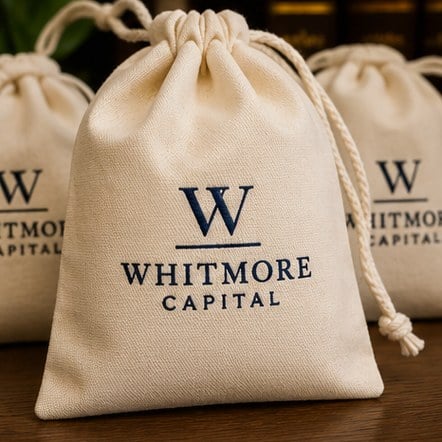
    Custom Canvas Banker Bags - one of the custom banker bags styles from Custom Banker Bags
    Custom Canvas Banker Bags.

    Does embroidery or printing cost more on banker bags?

    Embroidery on banker bags is usually quoted higher than a simple printed mark, because embroidery is priced by stitch coverage, thread colors and placement, while printing depends mainly on the number of ink colors and screens. Embroidery is also the method most firms choose for a heritage look, which is why it dominates custom embroidered deal bags.

    Several decoration details move the number:

    • Logo size and density. A small monogram uses far fewer stitches than a large, filled crest.
    • Thread or ink colors. Each extra color adds setup and handling, so matching a firm palette exactly can add work.
    • Number of placements. A logo on the front plus a deal name on the back is two decoration runs, not one.
    • Fabric compatibility. Velvet and suede need careful handling under the needle, which can affect how a design is digitized.

    A clean vector logo keeps decoration costs predictable. Custom Banker Bags digitizes and adapts your artwork as part of the free mockup, so you see the stitched or printed result before committing.

    How much does personalizing each bag add to a quote?

    Personalizing each bag adds to a quote because every variation needs its own setup, even when the base design stays the same. A run of identical banker bags is decorated in one continuous pass, while a run with a different recipient name, deal name or closing date on every bag must be handled one at a time.

    Personalization is often the most meaningful part of the gift, so it is worth pricing rather than cutting by default. Common options include:

    • Individual names or initials for each deal team member or board director
    • A transaction name and closing date for a deal memento
    • Property addresses for real estate closing gifts
    • Co-branded marks when two firms share a closing or sponsorship

    To keep the cost under control, send the full name list in a single spreadsheet with the spelling confirmed. Late changes to a personalized list create rework, and a clean list is the easiest way to keep a personalized order on the standard timeline of about 2 weeks.

    Do closures, linings and construction details affect the price?

    Closures, linings and construction details do affect the price of custom banker bags, though usually less than material or decoration. A zipper adds hardware and sewing steps compared with a drawstring, an interior lining adds fabric and labor, and a flat-bottom gusset takes more cutting than a flat pouch.

    The custom zippered document bags are a good example. A zippered document bag protects closing binders and contracts better than a drawstring bag, and that extra protection shows up in the construction cost. For firms that hand over sensitive paperwork, the trade-off is usually worth it.

    Other construction choices that shape the quote include:

    • Hardware finish on zipper pulls and grommets
    • Reinforced stitching for heavier contents
    • Contrast trim or piping in a firm color
    • Bag size, since larger bags use more material

    If you are unsure which construction fits, describe what the bag will carry and how often it will be used. Custom Banker Bags can recommend a build that matches the job without over-engineering it.

    How does order quantity change the cost per bag?

    Order quantity changes the cost per banker bag because setup work, such as digitizing a logo, preparing screens and sampling thread colors, happens once per design and is then shared across every bag in the run. A larger order spreads that fixed work across more units, so the per-bag figure generally falls as quantity rises.

    The minimum at Custom Banker Bags is 12, which makes small runs practical for a deal team, a partner group or a board. For bigger audiences, such as finance conferences or firm-wide onboarding, quoting a few quantity levels side by side shows where the per-bag figure flattens out.

    One caution: ordering far more than you need to reach a better per-bag number rarely saves money overall. Base the quantity on recipients plus a small reserve for new hires, late additions or replacements, and ask for a second quantity level on the same quote if you want to compare.

    How do you get an accurate quote for custom banker bags?

    The fastest way to get an accurate quote for custom banker bags is to send a complete brief in one request. Custom Banker Bags returns a free mockup within 24 hours, and the more detail the first message contains, the closer the first quote will be to the final one.

    1. Quantity. Your best estimate, plus any alternate quantity you want compared.
    2. Material. Canvas, velvet, suede or leather, or ask for a recommendation.
    3. Closure and size. Zippered or drawstring, and what the bag needs to hold.
    4. Artwork. A vector logo file if you have one, plus brand colors.
    5. Personalization. Whether names, deal details or dates vary bag by bag.
    6. In-hand date. When the bags must arrive, and where they ship.

    Submit the brief through the quote form. You pay nothing until you approve the design, revisions are unlimited and free, and the standard turnaround is about 2 weeks, with faster turnaround available with express shipping. The how it works page walks through each step from mockup to delivery.

    Frequently asked questions

    Why do two quotes for custom banker bags look so different?

    Custom banker bags are priced from the full specification, so two quotes can differ widely when the material, decoration or personalization changes. Leather with an individual name on every bag sits well above embroidered canvas with one shared logo. Compare quotes line by line on material, stitch coverage, closure and quantity before deciding which supplier offers better value for your firm.

    Which banker bag material gives the most value for a large conference order?

    Canvas banker bags usually give the most value for a large conference order, because canvas is the most economical material and takes embroidery and printing cleanly. Custom Banker Bags can suggest a heavier canvas when the handout should still feel substantial. Velvet, suede and leather are better reserved for smaller runs of partner, board or closing gifts.

    Does adding a second logo placement raise the price of banker bags?

    A second logo placement on banker bags does raise the price, because each placement is a separate decoration run with its own setup and handling. A front logo with a deal name on the back counts as two placements. If budget is tight, combining both marks into one front design often keeps the look while removing a full decoration step.

    Are zippered banker bags more expensive than drawstring styles?

    Zippered banker bags are generally more expensive than drawstring styles, because the zipper adds hardware and extra sewing steps. Custom Banker Bags recommends zippered document bags when the contents are contracts, closing binders or other sensitive paperwork. Drawstring bags suit gifts and lighter contents where quick access matters more than a fully sealed opening.

    How can a firm lower the cost of custom banker bags without looking cheap?

    A firm can lower the cost of custom banker bags by choosing a heavier canvas instead of leather, keeping embroidery to one clean placement and limiting thread colors. A single tasteful monogram often reads as more premium than a crowded design. Custom Banker Bags can show both options in the free mockup so you can compare them side by side.

    Is personalizing every banker bag with a name worth the extra cost?

    Personalizing every banker bag with a name is usually worth the extra cost for deal teams, board members and closing clients, because a named bag is far more likely to be kept and used. For large conference handouts, a shared logo is the practical choice. Custom Banker Bags quotes both versions so you can weigh the difference directly.

    What information should I include when requesting a banker bag quote?

    A banker bag quote request should include quantity, preferred material, closure style, size or intended contents, your logo file, any personalization and the date the bags must arrive. Custom Banker Bags uses that brief to return a free mockup within 24 hours. Missing details lead to assumptions, and assumptions are the main reason a first quote changes later.

    Do custom banker bags cost less if I order more than the minimum?

    Custom banker bags generally cost less per bag as the order grows past the minimum of 12, because setup work is shared across more units. The total still rises with quantity, so order for your real recipient list plus a small reserve. Custom Banker Bags can quote two quantity levels together so the trade-off is easy to see.

    Are there setup or artwork fees on custom banker bag orders?

    Custom banker bag orders include artwork preparation as part of the process, and the free mockup arrives within 24 hours with unlimited free revisions. Decoration setup is built into the quote rather than hidden later. Custom Banker Bags shows the full picture before you approve, and you pay nothing until the design is signed off by your team.

    Does a rush deadline change the cost of custom banker bags?

    A rush deadline can change the cost of custom banker bags, mainly through express shipping when the standard turnaround of about 2 weeks is too long. Faster turnaround is available, so share your in-hand date in the first request. Custom Banker Bags will confirm whether the date works and what the faster option involves before you approve anything.

    Can I get one quote that covers several banker bag materials?

    One quote can cover several banker bag materials, which helps when a firm wants leather for partners and canvas for the wider team. Custom Banker Bags can price each tier on the same request and show matching mockups. Splitting an order this way keeps the branding consistent while directing the premium budget to the recipients who matter most.

    Get a free mockup for your banker bags

    Send your logo or idea and the quantity you have in mind. Custom Banker Bags returns a free mockup within 24 hours, you approve the design before anything is produced, and standard turnaround is about two weeks with faster options available. Get a custom quote.
  • Canvas Banker Bags as Conference & Board-Meeting Handouts

    Canvas Banker Bags as Conference & Board-Meeting Handouts

    Canvas Banker Bags as Conference & Board-Meeting Handouts

    A stack of loose handouts at a board meeting or a banking conference gets shuffled, dropped, and left behind by lunch. Canvas banker bags solve that in one move: attendees get a sturdy carryall for the agenda, the annual report, and a laptop, and the bank or credit union gets a branded item that keeps circulating long after the meeting adjourns. Because the bag is structured rather than a flimsy drawstring pouch, printed materials inside stay flat and presentable through a full day of sessions.

    This guide covers what makes canvas banker bags work as a handout, the canvas weight that holds a full document set without sagging, and how to budget an order for a conference or an annual board meeting.

    Why canvas banker bags outperform a generic tote

    A generic printed tote is thin and shapeless; a canvas banker bag holds its shape empty and full, which is exactly what a handout bag needs to do on a table full of binders and swag. The structured base and full zip closure mean an attendee can drop the bag in a rideshare or overhead bin without the contents spilling, and the rectangular profile fits a laptop and a folder side by side better than a soft slouchy bag.

    Because the format doubles as an everyday work bag, recipients keep using it long after the conference — carrying it to the office, to client meetings, to the next event. That extended life is the real value of choosing canvas banker bags over a throwaway tote: the branding keeps traveling for months instead of getting tossed in a hotel room.

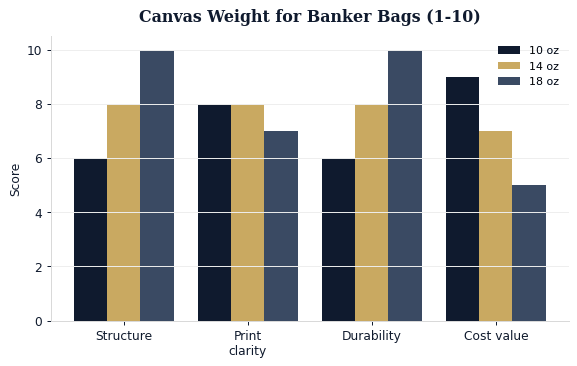
    Canvas weight compared across structure, print clarity, durability, and cost.
    Canvas weight compared across structure, print clarity, durability, and cost.

    Choosing the right canvas weight

    10oz canvas is light and affordable but sags once loaded with a binder and a laptop — fine for a light giveaway, not for a document-heavy handout. 12oz canvas is the sweet spot for most conference and board orders: structured enough to stand upright, still economical at volume. 16oz canvas is the premium choice for a smaller VIP or board-level run where a substantial, almost briefcase-like feel matters.

    If your event includes a printed annual report or a bound agenda, size the bag to that document first. A bag that swallows a standard binder without folding it is the detail attendees notice, even if they can’t say why the bag feels ‘nicer.’ For document-bag sizing across our lineup, see our companion Custom Banker Bags for Credit Unions & Community Banks.

    Planning a handout order for a conference or board meeting

    Start with what goes inside. A typical conference kit — agenda, name badge, a folded annual report, a pen, and maybe a small gift — fits comfortably in a mid-size canvas banker bag with room for a laptop. A board meeting handout can run smaller if it is just a bound packet and a folder, which lets you choose a more compact, premium bag at a lower unit cost.

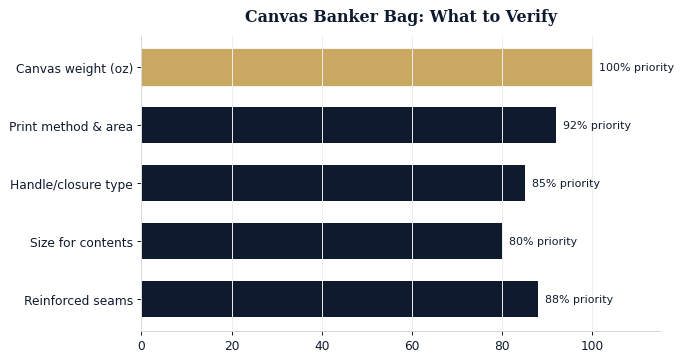
    The checklist below is what we walk conference and communications teams through before approving a print-ready order, since these are the details that separate a bag that holds up through the event from one that fails by the afternoon session.

    What to verify before approving a canvas banker bag for a conference or board handout.
    What to verify before approving a canvas banker bag for a conference or board handout.

    Budgeting the order

    The table below matches canvas weight and order size to the most common conference and board scenarios, so you can brief a supplier with a clear spec instead of a vague ‘something like a tote bag’ request.

    Occasion Canvas weight Order size
    Board meeting (annual) 16oz, premium trim 25โ€“75
    Regional conference 12oz, single-color print 250โ€“750
    National conference 12oz, full-color print 1,000+

    Confirm your printed materials’ dimensions before finalizing bag size, and lock artwork early so print and stitching stay on schedule for the event date. For sizing a document-focused bag correctly the first time, see our companion Custom Banker Bags for Credit Unions & Community Banks, and browse the full custom banker bags lineup, or read how it works before you brief a large conference order.

    Coordinating the bag with the rest of the conference kit

    A canvas banker bag rarely travels alone — it usually needs to hold a name badge, a lanyard, printed sessions materials, and often a small giveaway item, so the bag’s interior layout matters as much as its outer branding. An interior slip pocket keeps a phone or badge from sliding to the bottom under a stack of papers, and a pen loop is a small touch that attendees notice even if they can’t articulate why the bag feels more thought-through than a plain tote.

    Timing the bag order against your printed materials matters too. If the annual report or program guide is still being finalized, hold off on locking the bag’s exact interior dimensions until you know the bound document’s thickness, since a report that’s thicker than expected can make a snug bag feel undersized on-site. Confirming print specs before bag specs, rather than the reverse, avoids a last-minute scramble to fit oversized materials into an already-ordered bag.

    For board meetings specifically, consider whether the bag itself should carry meeting materials or whether it’s purely a keepsake handed out separately from a folder. Some boards prefer the bag to arrive empty as a gift, with materials distributed in a simpler folder at check-in; others want everything consolidated into the bag itself for a single, tidy handoff. Deciding this early changes both the bag’s ideal size and how many you actually need to order.

    Order a handful of extras for staff and press

    Beyond your registered attendee count, budget a small number of extra bags for staff, speakers, and any press in attendance. These groups often need the same materials and appreciate the same branded bag, and running short in front of a reporter is a worse outcome than a few unused spares.

    Lead time for a print-ready canvas bag order is longer than most first-time buyers expect, especially for a large national conference where the supplier is also fulfilling other clients’ event-season orders at the same time. Locking artwork, canvas weight, and quantity at least six to eight weeks before the event date gives enough room for a proof, a production run, and shipping with a buffer for the inevitable last-minute headcount change. Waiting until final registration numbers are in before placing the order is tempting but risky; ordering against a confident estimate and adjusting with a smaller top-up order later is usually the safer path for a date that can’t move.

    If the same conference or board meets annually, treat the first order as the template for every future one rather than reinventing the brief each year. Save the approved canvas weight, thread color, print placement, and quantity split by role in a single reference document, and next year’s order becomes a quick confirmation call instead of a full re-spec. This also gives you a natural point to evaluate whether the format still fits — a growing conference may need to step down in canvas weight to hit budget at higher volume, while a shrinking board meeting might upgrade to a nicer trim now that fewer bags are needed.

    Frequently asked questions

    What canvas weight is best for a conference handout bag?

    12oz canvas is the standard choice — structured enough to hold a binder and laptop without sagging, and priced to work at conference volumes of several hundred to a few thousand bags.

    Can canvas banker bags fit a laptop as well as documents?

    Yes, a mid-size canvas banker bag comfortably fits a laptop alongside a folded agenda and folder, which is part of why attendees keep using the bag well after the event ends.

    Planning a conference or board handout?

    Tell us your attendee count and materials and we’ll spec canvas banker bags that hold up all day.

    Get a Firm Quote

  • Zippered vs Drawstring Banker Bags: A Security & Use-Case Guide

    Zippered vs Drawstring Banker Bags: A Security & Use-Case Guide

    Zippered vs Drawstring Banker Bags: A Security and Use-Case Guide

    The closure is where security and speed trade off, which makes zippered bank bags versus drawstring the second real decision after size. Zippered bags — especially locking versions — protect contents and deter casual tampering; drawstring bags open and close in a second and cost less. This guide compares the two so you can match the closure to how the bag is actually used.

    There’s no universally right answer. A night-deposit run has different needs than a branded onboarding tote, and the best firms often carry both.

    Zippered vs drawstring: the trade-offs

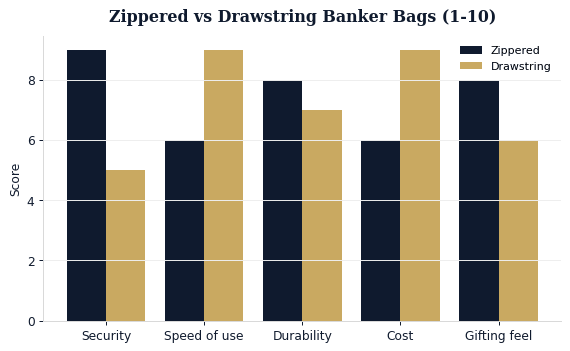
    Zippered bank bags win on security and gifting feel, while drawstring wins on speed and cost. Durability is close, though a quality zipper outlasts a frayed drawstring channel over years of heavy use. The scores below summarize how the two closures compare on the criteria buyers weigh.

    Zippered bags lead on security and feel; drawstring leads on speed and cost.
    Zippered bags lead on security and feel; drawstring leads on speed and cost.

    For anything holding cash or sensitive documents, a zipper — ideally lockable — is worth the small premium. For internal transport, supply organization, or gifting where security isn’t the point, drawstring is faster and cheaper.

    Matching closure to use case

    Cash deposits and controlled documents call for zippered, lockable bags with a tamper-evident option. Coin transport and internal moves are fine with drawstring. For client gifts and onboarding kits, choose based on the impression you want: a zipper feels more finished and premium, a drawstring tote feels casual and everyday.

    Handling regular deposits? Spec a lockable zipper with keyed or numbered seals so the bag itself is part of your cash-control process, not just a container.

    Zipper quality matters

    Not all zippers are equal. Heavy-gauge metal or reinforced nylon coil zippers with a lockable pull hold up far better than a light plastic tooth under daily strain. If you’re paying for security, pay for the zipper that delivers it.

    Cost by quantity

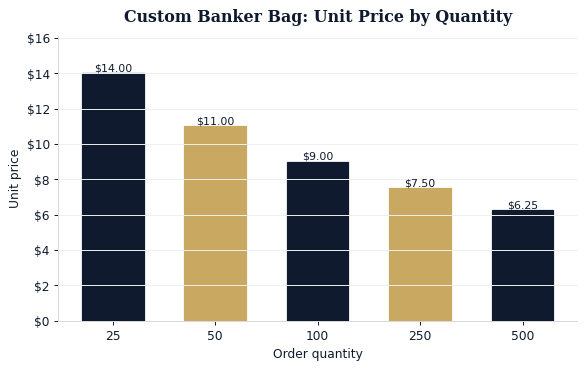
    Both closures get cheaper per unit with volume, and the gap between them narrows at scale. The curve below shows typical custom banker-bag pricing as quantity rises — useful for budgeting a firm-wide order.

    Per-unit custom banker bag pricing falls as order quantity increases.
    Per-unit custom banker bag pricing falls as order quantity increases.
    Use case Recommended closure Why
    Cash deposits Zippered, lockable Security, tamper-evidence
    Coin/internal transport Drawstring Speed, low cost
    Client gifts Zippered tote Premium feel
    Onboarding kits Either Match to brand tone

    Still deciding on dimensions? Start with our companion guide, our Banker Bag Sizes Explained: Coin, Currency & Deposit Dimensions. See how it comes together on how it works, then get a firm quote for your firm.

    Compliance, chain of custody, and record-keeping

    For regulated cash handling, the bag is part of a documented process, and the closure you choose should support it. Zippered bags that accept a lock and a numbered, tamper-evident seal let staff record the seal number at close, so any interference is visible on receipt. Pairing that with a simple log โ€” bag serial, seal number, amount, and handler โ€” creates a clean chain of custody that stands up to audit and reduces disputes over shortages.

    Drawstring bags rarely fit this role because they cannot be sealed reliably, which is why they stay on the internal side of the workflow. When you are choosing closures for a branch or firm, map each step of your cash journey and assign the closure that matches its risk: sealed zippers where money is controlled and counted, quick drawstrings where materials simply move from one desk to another.

    Security features beyond the basic closure

    The zipper-versus-drawstring choice is the headline, but the security details underneath matter just as much for cash handling. Lockable zipper pulls accept a keyed or combination lock, turning the bag into a controlled container; tamper-evident numbered seals let you verify at a glance whether a bag was opened in transit. Some deposit programs pair a zippered bag with a printed serial or barcode so each bag is trackable through a chain of custody. If your bag is part of a cash-control process, these features do more work than the closure alone.

    Drawstring bags can carry light security touches too โ€” a toggle lock or a seal loop โ€” but they are fundamentally quick-access containers rather than secured ones. That is exactly why they shine for internal transport and organization, where speed matters and the contents are not sensitive. Match the security layer to the sensitivity of what the bag carries, not to a blanket rule.

    Durability, maintenance, and total cost of ownership

    Over years of daily use, the closure is often what fails first, so build quality there drives the real cost of ownership. A heavy-gauge metal or reinforced nylon-coil zipper with a robust pull outlasts a light plastic tooth by a wide margin, and it is worth the small premium on any bag opened and closed dozens of times a day. Drawstrings fail differently โ€” fraying at the channel or a worn toggle โ€” so a bag with a replaceable cord and reinforced eyelets extends its life cheaply.

    Maintenance is minimal but real: keep zippers free of grit, occasionally run a little zipper lubricant on heavily used bags, and inspect drawstring channels for wear. Choosing a bag whose closure and stitching are built for your usage volume means fewer replacements, which usually outweighs a lower sticker price on a flimsier bag.

    Matching closure to workflow and staff habits

    The best closure also fits how your people actually work. If tellers or staff open and close a bag many times per shift, a smooth zipper or a quick drawstring that does not snag keeps the line moving; a fussy closure gets propped open, which defeats its purpose. For end-of-day deposits handled once and secured, a lockable zipper’s slower operation is a non-issue and its security is the point.

    Consider ergonomics and gloves, too: larger pulls and toggles are easier to operate quickly and in cold conditions. Piloting a small batch with the team before a full rollout surfaces these workflow details early, so the bag you standardize on is one staff will use correctly every time rather than working around.

    Common questions about banker bag closures

    Are zippered bank bags worth the extra cost?

    For anything holding cash or sensitive documents, yes โ€” a zipper, ideally lockable, protects contents and deters casual tampering for a modest premium. For internal transport and organization where security is not the concern, drawstring is faster and cheaper and a better fit.

    Can drawstring bags be made secure?

    Drawstring bags accept light touches like a toggle lock or seal loop, but they remain quick-access containers rather than truly secured ones. When you need controlled access or tamper evidence, choose a lockable zippered bag.

    Which closure lasts longer?

    Durability is close, but a quality metal or reinforced nylon-coil zipper generally outlasts a drawstring channel under heavy daily use. Whichever you choose, a replaceable cord or a heavy-gauge zipper and reinforced stitching are what determine real longevity.

    Should a firm standardize on one closure?

    Most firms are best served by both: lockable zippered bags for deposits and controlled documents, and drawstring bags for coin, internal moves, and non-sensitive gifting. Standardizing the closure by use case keeps costs down and staff habits consistent.

    Choosing the right closure for your firm?

    We’ll match zippered or drawstring bags to your use case, security needs, and branding.

    Get a Firm Quote

  • Banker Bag Sizes Explained: Coin, Currency & Deposit Dimensions

    Banker Bag Sizes Explained: Coin, Currency & Deposit Dimensions

    Banker Bag Sizes Explained: Coin, Currency, and Deposit Dimensions

    Before you order, it helps to know that banker bag sizes are not arbitrary — each dimension maps to a job, from holding a roll of coin to carrying a full day’s deposit or serving as a branded client gift. Order the wrong size and you either can’t close the bag or you’re paying for canvas you don’t need. This guide lays out the standard banker bag sizes, what each is built for, and how firms actually use them.

    Whether you’re a bank stocking cash-handling supplies or a firm speccing a branded gift, matching the size to the use is the single decision that determines whether the bag gets used or shoved in a drawer.

    The standard banker bag sizes

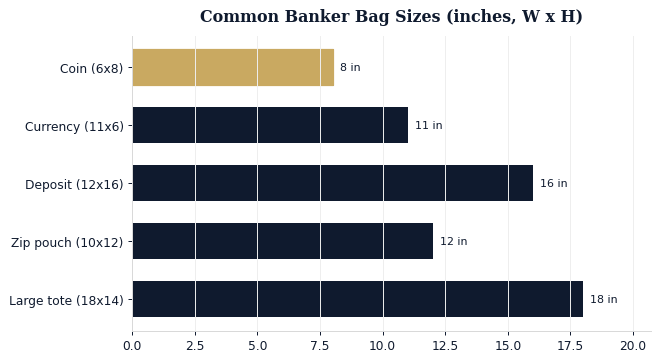
    Banker bags cluster around a handful of common footprints. Coin bags are small and tall to hold weight without splaying; currency bags are wider and shallower to lay bills flat; deposit bags are the largest, sized to swallow a full till. Zip pouches and totes round out the range for documents and gifting.

    Common banker bag footprints, from compact coin bags to large totes.
    Common banker bag footprints, from compact coin bags to large totes.

    If you’re unsure, size up slightly: a bag that closes easily with room to spare lasts longer and looks better than one straining at the seams. Overstuffed canvas wears at the stitch lines first.

    How firms actually use each size

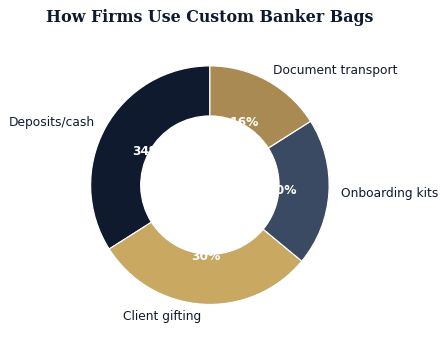
    Usage splits across cash handling, gifting, onboarding, and document transport. Banks lean on coin and currency bags for daily operations; law and finance firms lean on totes and zip pouches for client gifts and welcome kits. The mix below reflects what most custom orders are for.

    Custom banker bags serve cash handling, client gifting, onboarding, and document transport.
    Custom banker bags serve cash handling, client gifting, onboarding, and document transport.
    For gifting and onboarding, choose a slightly larger tote in a heavier canvas — it reads as premium and gets reused, which keeps your logo in circulation far longer than a functional deposit bag would.

    Canvas weight and size interact

    Bigger bags need heavier canvas. A large deposit or tote bag in a light canvas will sag and distort; a coin bag in heavyweight duck feels needlessly stiff. Match ounce-weight to size so the bag holds its shape under a realistic load.

    Speccing the right size for your order

    Start from the contents: measure what the bag must hold, add a small margin, then pick the nearest standard footprint. Confirm the closure and whether you need a gusset for depth. For branded orders, leave a clean imprint area on the front panel that your logo can own.

    Bag Typical size Best for
    Coin 6×8 in Rolled coin, small cash
    Currency 11×6 in Flat bills, daily deposit
    Deposit 12×16 in Full till, night drop
    Tote 18×14 in Gifting, onboarding

    Once size is set, closure is the next call — see our companion guide, our Zippered vs Drawstring Banker Bags: A Security & Use-Case Guide. Learn our process on how it works, then get a firm quote for your firm’s order.

    Measuring your contents before you choose a size

    The most reliable way to land on the right banker bag size is to measure what the bag has to hold before you shop. For cash handling, stack the bills or coin rolls you move in a typical run and measure the footprint and height, then add a small margin so the bag closes without strain. For document transport, measure your largest folder or binder flat; for gifting and onboarding, think about the kit contents โ€” a notebook, a bottle, a few smaller items โ€” and size to the bulkiest combination.

    That quick measurement prevents the two classic mistakes: a bag so tight it splits at the seams under a full load, and an oversized bag that wastes canvas and slumps when half full. When a measurement falls between two standard footprints, size up slightly for cash and documents, where a little slack extends life, and size closer to the contents for gifting, where a trim, structured bag looks more premium.

    Materials, hardware, and how they change the size decision

    Banker bag sizes do not exist in isolation from the material and hardware wrapped around them. Heavier canvas holds shape at larger footprints, which is why deposit bags and totes should step up in ounce-weight as they grow; a large bag in light canvas sags and distorts under load. Smaller coin and currency bags can use a mid-weight canvas without feeling flimsy, keeping them easy to handle.

    Hardware scales with size too. Larger bags benefit from reinforced stitching at stress points, wider gussets for depth, and sturdier zippers or drawstrings sized to the opening. For branded totes, a flat front panel and a slightly structured base give your logo a clean canvas and help the bag stand on a desk. Spec the material and hardware alongside the dimensions so the finished bag performs at the size you chose.

    Standardizing sizes across a firm or branch network

    Organizations that buy at scale get the most from a small, deliberate size lineup rather than a different bag for every task. A typical kit is a coin bag and a currency bag for daily cash handling, a deposit bag for end-of-day, and a branded tote for gifting and onboarding. Standardizing on those footprints simplifies reordering, keeps branding consistent, and makes it easy for new branches to order the same set without re-deciding every time.

    A shared spec sheet โ€” footprint, canvas weight, closure, and imprint area for each bag โ€” turns reorders into a one-line request and keeps the whole network on-brand. It also makes budgeting predictable, since per-unit pricing improves as you consolidate volume onto fewer, standardized sizes instead of scattering small runs across many custom footprints. When a new branch opens, it simply orders the same documented set, and your finance team can forecast the spend without re-quoting every line.

    Common questions about banker bag sizes

    What is the difference between a coin bag and a currency bag?

    A coin bag is small and tall so it holds weight without splaying, while a currency bag is wider and shallower so bills lay flat. Choose the coin footprint for rolled coin and small cash, and the currency footprint for daily bill deposits.

    How much bigger than my contents should the bag be?

    Leave a small margin so the bag closes easily with a little room to spare. For cash and documents, err slightly larger to extend seam life; for gifting, keep it closer to the contents for a trim, premium look.

    Does canvas weight need to match the size?

    Yes. Larger bags need heavier canvas to hold their shape under load, while smaller bags can use a mid-weight duck comfortably. Matching ounce-weight to footprint prevents sagging on big bags and needless stiffness on small ones.

    Can one bag work for both deposits and gifting?

    A mid-size tote can stretch across light deposit duty and gifting, but dedicated footprints usually perform better: a structured deposit bag for cash, and a heavier, cleaner tote for branded gifts. Many firms carry both and reserve the premium tote for client-facing use, which keeps the everyday cash bags purely functional and the gift bags looking their best.

    Not sure which size your firm needs?

    Tell us what the bags will carry and we’ll match the size, canvas weight, and branding.

    Get a Firm Quote

  • Custom Banker Bags: A Buyer’s Guide for Banks & Cash Handling

    Custom Banker Bags: A Buyer’s Guide for Banks & Cash Handling

    Custom Banker Bags: A Practical Buyer’s Guide for Cash Handling

    Custom banker bags are the quiet workhorse of any cash operation, moving currency, coin and deposits between the till, the vault and the branch without drawing attention. Whether you run a community bank, a credit union, or a multi-lane retail store, the right bag protects money in transit, speeds reconciliation, and puts your name on every deposit that crosses the counter. This guide walks through the material, closure, security and sizing decisions so you can spec custom banker bags that hold up to daily use and match the way your team actually handles cash.

    Canvas vs. Vinyl vs. Nylon: Match the Material to the Route

    The first decision is the body material, and it comes down to how far and how often the bag travels. Heavy cotton canvas (typically 18oz to 24oz duck) is the traditional choice: it is quiet, tough, and takes a printed or embroidered logo cleanly, which is why most branded deposit bags are canvas. Vinyl and coated fabrics wipe clean and shrug off rain, so they suit armored-car routes and outdoor drop runs. Ripstop nylon splits the difference, staying light for tellers who fill and empty bags dozens of times a shift.

    As a rule of thumb, canvas wins on branding and feel, vinyl wins on weatherproofing and easy cleaning, and nylon wins on weight. For most branch and retail use, a mid-weight canvas with a reinforced base is the sweet spot.

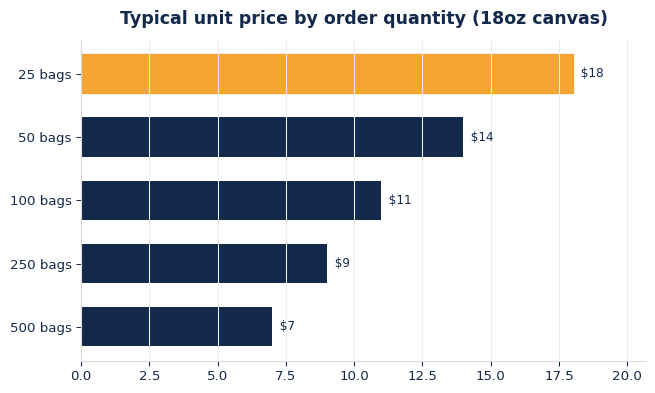
    Typical unit price for custom banker bags by order quantity.
    Typical unit price for a printed 18oz canvas deposit bag as order quantity increases.

    Closures and Security: Zipper, Lock or Tamper-Evident

    How the bag closes decides how much you can trust it unattended. A simple zipper bag is fine for internal transfers where the bag never leaves staff hands. A key or combination locking bag adds accountability when cash moves between people or buildings, since only a supervisor holds the key. For deposits that leave your control, a tamper-evident tote with a serialized security seal is the standard: the seal number is logged at fill and checked on receipt, so any interference is obvious.

    Which to choose

    Match the closure to the weakest point in your chain of custody. Internal-only? A branded zipper bag is enough. Handing bags to a courier or night-drop? Use tamper-evident, single-use seals and record the numbers. Many banks run two systems at once: reusable locking bags inside the branch and disposable tamper-evident bags for outbound deposits.

    Sizing: Coin, Currency and Deposit Formats

    Bag size should follow what goes inside, not the other way around. Coin is dense and heavy, so coin bags are small with a reinforced, often gusseted base that will not blow out under weight. Currency and check deposits ride flat, so a wider zippered wallet or tote shape keeps notes from creasing. If your team preps end-of-day deposits, a medium tote that holds banded straps plus a deposit slip is usually the most-used size.

    Order a spread of sizes rather than one universal bag, and label or color-code them by purpose so a coin bag never gets pressed into deposit duty. Consistent sizing also makes vault shelving and reconciliation faster.

    Bag typeBest contentsTypical closure
    Small coin bagLoose or rolled coinDrawstring or zipper, gusseted base
    Currency walletBanded notes, checksZipper or lock
    Deposit toteEnd-of-day depositsLock or tamper-evident seal
    Transit toteBranch-to-branch transfersLocking, reinforced handles
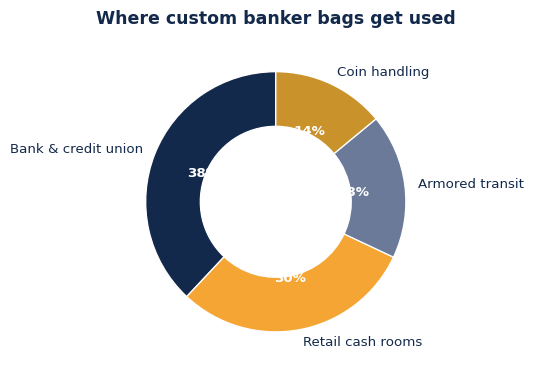
    How custom banker bag orders split across cash-handling use cases.
    How branded deposit bag orders typically split across cash-handling use cases.

    Quantity, Pricing and Lead Time

    Per-bag price falls as volume climbs, because the setup for screen printing or embroidery is a fixed cost spread across the run. The chart above shows how a printed canvas deposit bag trends with quantity; treat the numbers as illustrative ranges rather than a firm quote, since weight, closure hardware and seal serialization all move the figure. Locking and tamper-evident options add cost per unit, and serialized seals are usually priced separately by the box.

    Standard production for a branded run commonly lands in a two-to-four-week window after art approval, with rush options at a premium. Because banks reorder on a schedule, it pays to set a par level per branch and reorder before you hit it rather than scrambling when a size runs out.

    Tip: Standardize on one bag color per purpose across every branch (for example, blue for coin, tan for deposits) and print the branch name or number on the bag. It cuts sorting time at the vault and makes a misrouted bag obvious at a glance.

    Branding That Survives the Wash

    A deposit bag is handled constantly, so branding has to survive abrasion and the occasional cleaning. Screen printing is the most economical for bold, one or two color logos and holds up well on canvas. Embroidery reads premium and resists wear, which suits locking transit bags that stay in service for years. For vinyl, a heat-applied transfer or pad print bonds better than screen ink. Keep the logo simple and high-contrast; fine detail and gradients tend to fade or clog on rugged fabrics.

    Matching the Bag to Your Operation

    The right spec shifts with the setting. A community bank or credit union usually wants durable canvas locking bags for internal transfers plus tamper-evident bags for the night drop, all carrying the institution logo. A retail chain handling many tills leans toward color-coded zipper bags per register and a larger locking tote for the safe. An armored-carrier or courier relationship almost always mandates serialized tamper-evident bags, so confirm their seal and logging requirements before you order.

    Think about reconciliation, too. Bags that are labeled, color-coded and consistently sized make end-of-day counts faster and errors easier to trace, which is worth far more over a year than a few cents saved per bag.

    Common Mistakes to Avoid

    A few predictable errors undercut otherwise sound orders. The first is buying one universal size and forcing coin into a bag that cannot take the weight, which splits seams. The second is choosing a reusable zipper bag for outbound deposits that should be tamper-evident, leaving a gap in the chain of custody. The third is over-designing the logo so it clogs on canvas or peels on vinyl. Finally, buyers forget to serialize and log seals, which defeats the entire point of tamper-evident bags.

    Plan par levels per branch and reorder early, especially before quarter-end and holiday retail peaks when cash volume climbs and deposit bags disappear fastest.

    The Bottom Line

    The best custom banker bags come from three aligned decisions: pick a material that suits the route, choose a closure that matches your chain of custody, and size bags to the cash format they carry. Standardize colors and labeling across branches, keep branding simple enough to survive daily handling, and log your tamper-evident seals. Do that and your bags protect the money, speed reconciliation, and quietly carry your brand on every deposit.

    Ready to spec your custom banker bags?

    Send us your quantities, closure preference and logo, and we will recommend materials, sizes and a production timeline that fits your cash operation.

    Get a Quote

    More reading: browse our full range or learn how we produce custom banker bags. Questions on artwork or quantities? ask for a quote.

  • Custom Canvas Bags for Firms: Printing & Decoration Guide

    Custom Canvas Bags for Firms: Printing & Decoration Guide

    Custom Canvas Bags for Firms: Printing & Decoration Guide

    Every firm that orders branded bags faces the same three decisions, usually without anyone on staff who has made them before: which decoration method, which canvas weight, and where the logo goes. Get those right and your custom canvas bags look like something a managing director hands a client at closing. Get them wrong and they look like conference swag. This guide walks through the production side of the decision โ€” silkscreen versus embroidery, canvas weight in ounces, logo placement, and the cost implications of each โ€” so the person tasked with ordering can brief a supplier like they have done it a dozen times.

    Silkscreen vs. Embroidery: The Core Decision

    Nearly every decorated canvas bag is produced one of two ways, and the choice shapes cost, look, and durability more than any other factor.

    Silkscreen Printing

    Silkscreen (screen printing) presses ink through a mesh stencil directly onto the canvas. It excels at crisp, flat coverage: wordmarks, deal toy motifs, and single-color logos reproduce with sharp edges even at large sizes. Each color requires its own screen, so a one-color print is economical while a four-color design multiplies setup costs. On heavyweight canvas, quality silkscreen holds up through years of use, though high-friction areas can show gentle fading over time โ€” a look many firms actually like, since it reads as heritage rather than wear.

    Embroidery

    Embroidery stitches the logo in thread, producing texture and dimension that photography flattens but hands notice immediately. It signals investment โ€” the same reason it dominates on dress shirts and club blazers โ€” and it will not fade for the life of the bag. The trade-offs: fine serif type below roughly a quarter inch tall loses definition in thread, large solid areas become heavy and pucker lighter fabrics, and per-unit cost runs higher because machine time scales with stitch count.

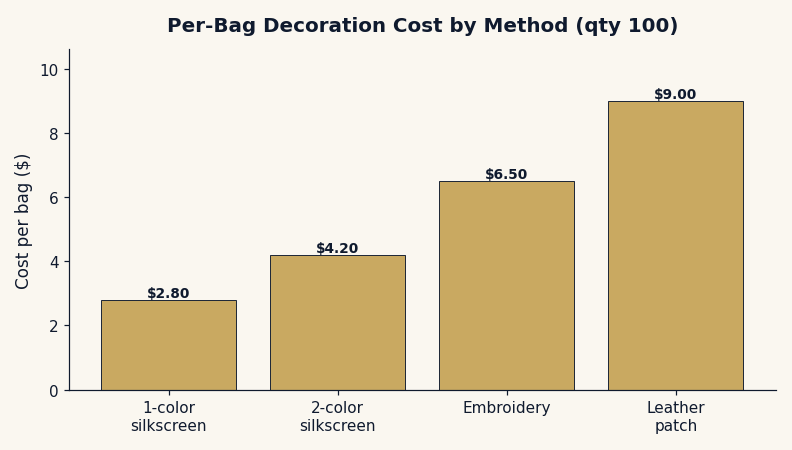
    Bar chart comparing per-bag decoration costs for custom canvas bags across one-color silkscreen, two-color silkscreen, embroidery, and leather patch
    Typical per-bag decoration cost at a 100-unit order. Setup fees are amortized into the unit figures shown.

    A practical rule we give firms: silkscreen for wordmarks and large graphics, embroidery for crests and small emblems. Law firms with engraved-plate style logotypes tend toward one-color silkscreen in a metallic or cream ink; wealth management groups with shield or crest marks tend toward embroidery.

    Canvas Weight: What the Ounces Mean

    Canvas is graded by weight per square yard, and the number tells you almost everything about how the bag will feel and last.

    Canvas weight Feel & structure Typical use Expected service life
    8โ€“10 ozLight, drapes, folds flatConference totes, giveaways6โ€“18 months of daily use
    12โ€“14 ozStructured, stands uprightClient gifts, everyday firm totes3โ€“5 years
    16โ€“18 ozRigid, holds its shape loadedBanker bags, closing gifts, document transport5โ€“10+ years
    20โ€“24 ozBoot-leather stiffnessHeirloom pieces, heavy equipmentA decade or more

    The classic banker bag lives in the 16โ€“18 oz range for a reason: it stands open on a desk while documents go in, shrugs off the corner of a redweld, and develops a patina instead of holes. If your bags will carry closing binders or laptop-plus-files daily, do not go below 14 oz. If they are a conference handout with a one-season life expectancy, 10 oz keeps costs proportionate to the job.

    Procurement tip: Ask your supplier for the canvas weight in writing on the quote. “Heavyweight canvas” is a marketing phrase, not a specification โ€” 12 oz and 18 oz are both sold under that label, and the difference is obvious the moment a partner picks one up.

    Logo Placement: Where the Mark Goes

    Placement affects both how the logo reads and how the bag ages around it.

    • Front panel, centered: The default, and the right answer for most firm totes. Sized at 30โ€“40% of panel width, it reads clearly across a conference room without shouting.
    • Front panel, offset lower-third: A quieter, more fashion-forward placement that pairs well with small embroidered crests. Popular with wealth management and boutique advisory firms.
    • Gusset (end panel): Puts the mark where it shows when the bag sits on a shelf or floor โ€” the placement of choice for document bags that live in file rooms.
    • Under-flap or interior: The understated option: the recipient knows, and that is the point. Increasingly requested for senior client gifts where discretion outranks visibility.

    Whichever placement you choose, insist on a scaled mockup showing the logo on the actual bag dimensions. A mark that looks balanced in a vector file routinely looks undersized on an 18-inch panel.

    Budgeting: Where the Money Actually Goes

    Firms are often surprised that the bag itself is only part of the unit price. Decoration method, canvas weight, and order quantity each move the number meaningfully.

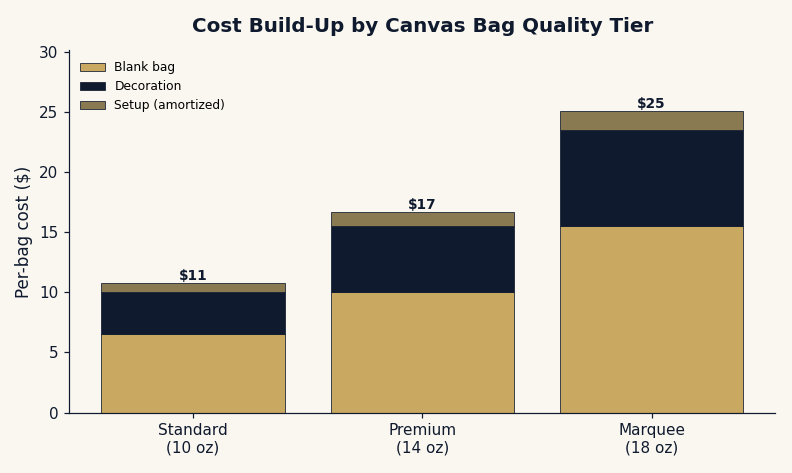
    Stacked bar chart showing how blank bag cost, decoration, and setup fees combine across three custom canvas bag quality tiers
    Typical landed cost per bag at 100 units across three common builds. Heavier canvas raises the blank cost; embroidery raises the decoration cost.

    Two budgeting behaviors separate experienced buyers from first-timers. They amortize setup fees mentally โ€” a $60 screen fee is 60 cents a bag at 100 units, so they never let setup charges push them into a worse decoration method. And they order roughly 10% overage on client-facing programs, because reprinting eight bags to cover new hires costs nearly as much in setup as the original hundred.

    Briefing Your Supplier: A Checklist

    When you request a quote, a complete brief gets you an accurate number the first time. Include: quantity (with reorder expectations), canvas weight, bag dimensions, decoration method and color count, logo files in vector format, placement, and your in-hands date. Suppliers quote conservatively when details are missing โ€” precision saves money.

    If you want to see how this process runs end to end โ€” artwork proofing, pre-production samples, and delivery โ€” our how it works page lays out each step. For sector-specific guidance, we keep dedicated pages for law firms and investment banks, since deal-closing gifts and case-file transport push the specification in different directions.

    And if the bags are destined for new-client programs rather than internal use, pair this guide with our companion piece on client onboarding kits for financial firms โ€” the decoration decisions are the same, but the packaging and presentation layer changes the brief.

    The Bottom Line

    Well-specified custom canvas bags come down to three matched choices: a decoration method that suits your logo’s structure, a canvas weight that suits the bag’s working life, and a placement that suits the setting where the bag will be seen. Firms that nail all three end up with a bag people keep for a decade โ€” which, per impression, makes it one of the cheapest pieces of marketing the firm will ever buy.

    Specify once. Order with confidence.

    Send us your logo and quantities โ€” we return a scaled mockup and firm pricing within one business day.

    Get a Firm Quote