Client Onboarding Kits for Financial Firms: Welcome Kits That Set the Tone
The first ninety days decide how a client talks about your firm for the next ten years. Most financial firms pour effort into the pitch and the paperwork, then let the actual welcome moment pass with a DocuSign confirmation email. That is the gap client welcome kits exist to fill. A well-built kit — delivered in the week after signing — turns an administrative milestone into a physical, brandable moment: something on the client’s desk that says the relationship matters before the first quarterly review ever happens.
This guide covers what belongs in a financial firm’s onboarding kit, three budget tiers with real numbers, how to anchor the kit around a piece the client will keep, and the logistics of assembling and shipping kits without burdening your operations team.
Why Welcome Kits Outperform Almost Any Other Client Gift
Gifting at the holidays is expected, and expected gifts earn little. A welcome kit arrives at the moment of maximum attention — the client just made a significant decision and is watching for evidence they chose well. Three things happen when the kit lands:
- It confirms the decision. A considered, branded package signals operational competence — the same quality the client is hoping shows up in your reporting and responsiveness.
- It creates the first referral artifact. Clients show welcome kits to spouses, partners, and colleagues. A holiday gift basket never gets that treatment.
- It sets the service tone. Firms that include a handwritten note and a named point-of-contact card in the kit report smoother onboarding calls, because the relationship already feels staffed by people rather than portals.
What Goes in the Kit: The Anatomy
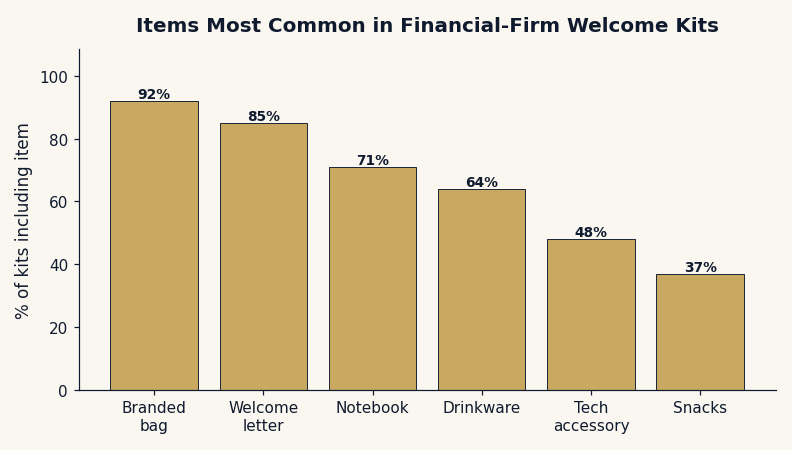
Across advisory, banking, and accounting firms, the kits that get talked about share a structure: one anchor item built to last years, two or three supporting items used weekly, and one personal touch that cannot be mass-produced.
The Anchor: A Bag Worth Keeping
The anchor item carries the brand for years, and this is where canvas earns its place. A heavyweight canvas banker bag with the firm’s mark embroidered on the gusset does double duty: it is the container the rest of the kit ships in, and it is the item that survives on the client’s desk or in their car long after the notebook is full. Unlike drinkware or tech accessories, a structured bag also photographs well in the unboxing moment — which matters more than most partners expect.
The Supporting Cast
A linen-bound notebook, a serious pen, and quality drinkware cover the weekly-use tier. Keep supporting items to three or fewer — kits with eight items read as promotional inventory clearance, not hospitality.
The Personal Layer
A handwritten welcome note from the lead advisor, a card with the service team’s names and direct lines, and — for larger relationships — something researched: coffee from the client’s hometown roaster, a book relevant to a conversation from the pitch process. This layer costs the least and gets mentioned the most.
Budget Tiers: Three Kits That Work
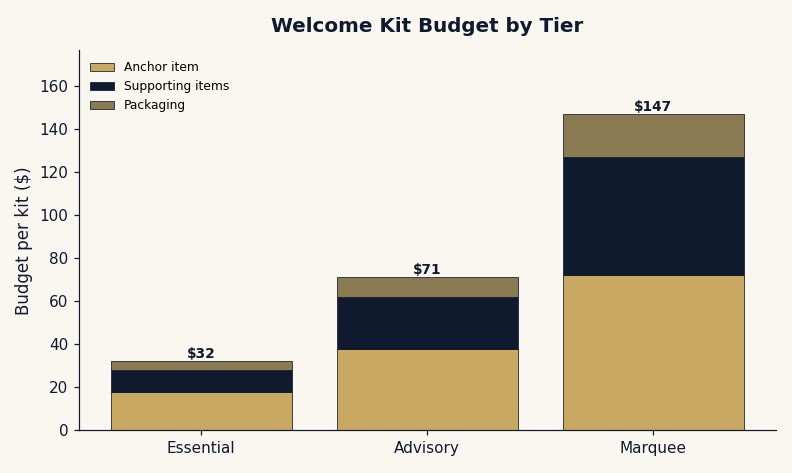
Kit budgets in financial services cluster around three tiers, usually mapped to relationship size or service line.
| Tier | Budget per kit | Contents | Typical use |
|---|---|---|---|
| Essential | $45–$65 | 12 oz canvas tote, notebook, welcome letter, team card | Retail banking, new accounting engagements |
| Advisory | $95–$140 | 16 oz embroidered banker bag, linen notebook, pen, drinkware, handwritten note | Wealth management, advisory retainers |
| Marquee | $180–$275 | 18 oz leather-trim bag, personalized item with client’s initials, researched personal gift, premium packaging | Institutional wins, eight-figure relationships |
Compliance Notes Worth Knowing
Financial firms operate under gift-giving rules that most promo vendors have never heard of. Two points to raise internally before launching a program: FINRA’s $100 gift limit applies to gifts to registered representatives of other firms, not to your own clients — but many broker-dealers apply internal thresholds to client gifts anyway, so route the program through compliance once at the design stage rather than kit by kit. And branded items your firm’s logo appears on are generally treated more leniently than unbranded luxury goods, which is one more argument for the embroidered bag over the unmarked bottle of scotch.
Logistics: Assembly Without the Headache
The programs that die are the ones where an office manager hand-assembles kits between closings. Three structural fixes: order components in matched quantities with 10% overage; have your bag supplier ship flat-packed with kitting instructions, or contract kitting outright; and hold a small reserve of “blank” kits that can be personalized within 48 hours for unexpected wins. A kit that arrives in week one beats a nicer kit that arrives in month two.
Our how it works page shows the proofing and production timeline for the bag component. For tier-specific examples, see how wealth management firms structure advisory-tier kits and how accounting firms time kits to engagement letters. And when you are ready to specify the bag itself — decoration method, canvas weight, and logo placement — our printing and decoration guide for firm canvas bags covers the production decisions in detail.
Start With the Moment, Not the Merchandise
The strongest client welcome kits are designed backward from the moment the box is opened: what should the client feel, and what should still be on their desk a year later? Answer those two questions, pick an anchor piece worthy of them, and the rest of the kit assembles itself. Firms that treat client welcome kits as a service-design decision — rather than a promo order — are the ones whose clients do the marketing for them.
Build an onboarding kit your clients show off.
Embroidered banker bags, kitting, and delivery — quoted for your tiers within one business day.
Get a Firm QuoteWin Free Stuff
Enter below for a chance to win plus receive 10% off your first order.
🎉 You are in!
Check your email for your 10% off code. Good luck!