Choosing a deposit bag looks simple until you are staring at a supplier catalog with a dozen sizes, two very different security philosophies, and a price range that runs from pennies to more than thirty dollars a bag. The right choice depends on how your cash moves: whether a bag makes a one-way trip to a night drop, or rides back and forth between a register and a safe for months. This walkthrough covers the decisions in the order you actually make them, so a custom order lands with the size, closure, and numbering your cash-handling process needs.
Start with the fork: single-use tamper-evident or reusable locking
The first decision drives everything else. Single-use tamper-evident bags are co-extruded polyethylene pouches with a permanent adhesive seal. Once closed they cannot be reopened without leaving visible damage, which makes them ideal for daily cash drops, shift-end tills, and anything headed to a night deposit or an armored pickup where the bag is opened only at the destination. Reusable locking bags are canvas or reinforced vinyl with a zipper and a keyed lock, built to make the same trip hundreds of times, typically in a swap-and-relock system where the bank or head cashier holds the key.
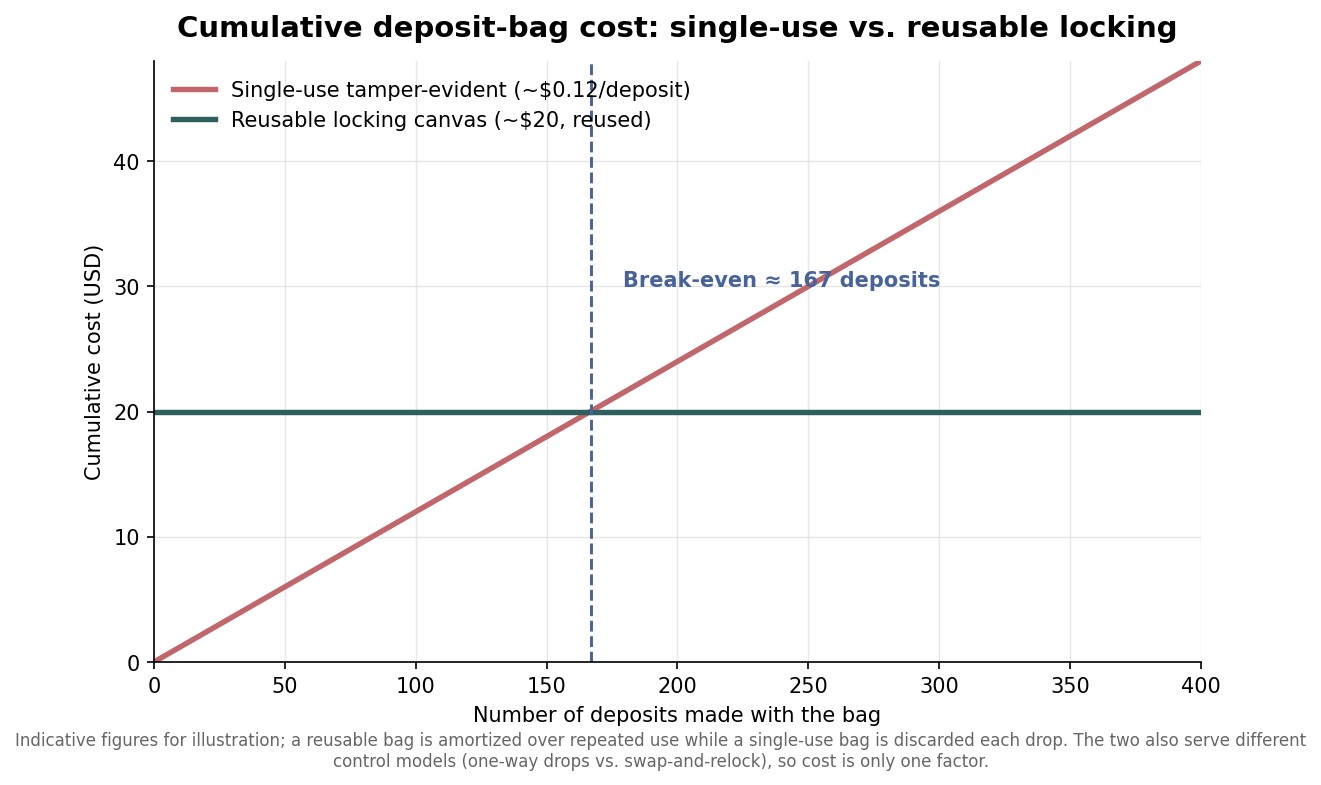
Cost follows directly from that choice. A single-use tamper-evident bag can run well under fifteen cents at volume, but you buy a new one for every deposit. A reusable locking canvas bag is often in the fifteen-to-thirty-dollar range for a single unit and less in quantity, but it amortizes over every trip it survives. The chart below shows the crossover using indicative figures: past roughly a couple hundred deposits, the reusable bag is cheaper per drop. That math only applies when the same bag genuinely gets reused, so treat it as a guide to amortization rather than a reason to switch control models.
Match the size to the deposit, not the other way around
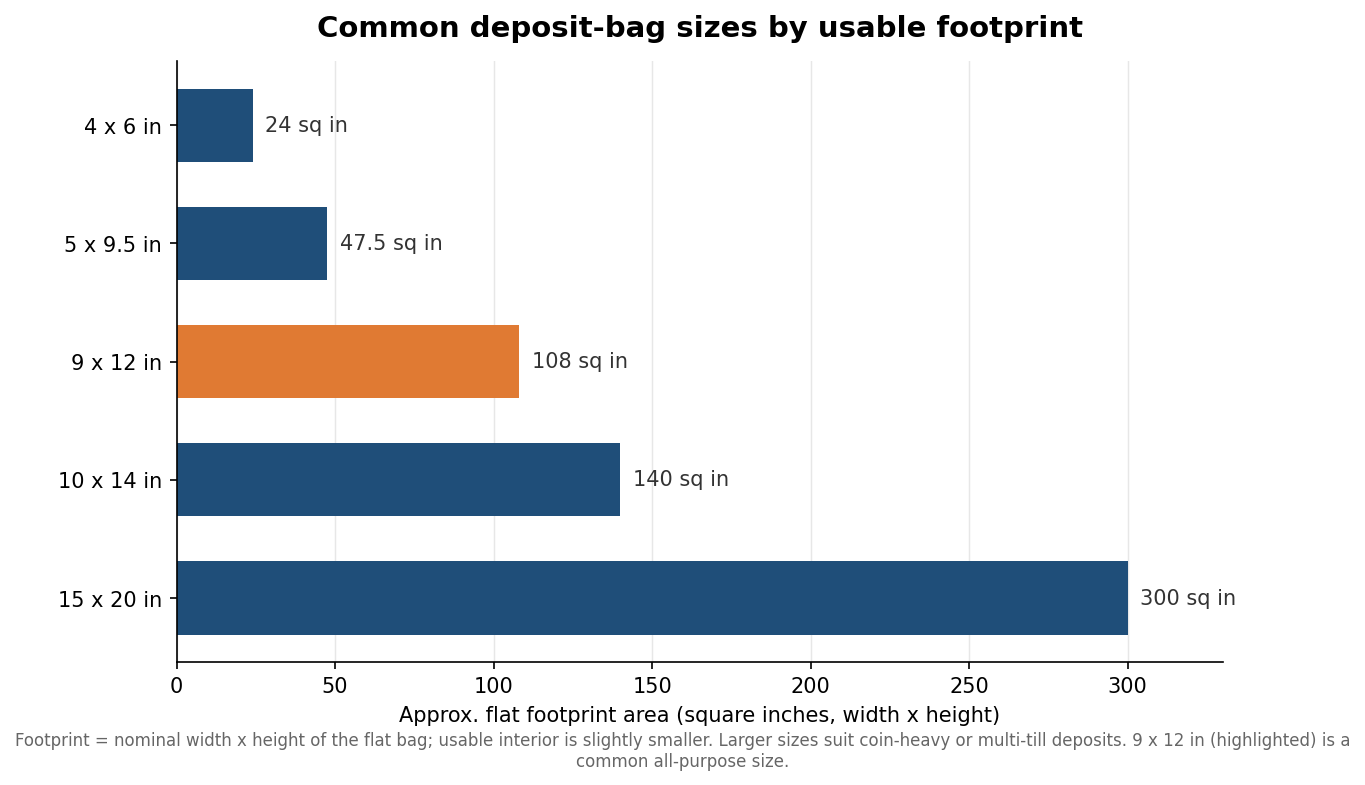
Undersizing is the most common ordering mistake. Bag sizes cluster around a familiar ladder: small pouches at 4 by 6 and 5 by 9.5 inches, mid-size bags at 9 by 12 and 10 by 14 inches, and large sacks at 15 by 20 inches and up. Coin is the variable that catches people out, because rolled coin is dense and bulky in a way that banded currency is not. A till drop that is mostly notes fits comfortably in a 9 by 12 bag, while a coin-heavy retail or laundromat deposit often needs the next size up or a gusseted sack. The figure below plots the usable footprint of each common size so you can see how quickly capacity grows as you move up the ladder.
Order a size that leaves the bag two-thirds full rather than straining at the seal, because an overstuffed tamper-evident closure is harder to seal cleanly and a jammed zipper shortens the life of a locking bag.
The tamper-evident features that actually matter
Not every feature printed on a spec sheet changes your risk. The ones that do are the closure and the audit trail. A permanent cross-cut or adhesive closure is the core of a single-use bag; it should tear or void visibly if someone tries to lift and reseal it. Sequential serial numbering with a matching tear-off receipt is what lets you reconcile a specific bag to a specific deposit, and it is the feature most worth insisting on for any process that touches an auditor. Look also for a high-visibility barcode, commonly around three-quarters of an inch tall, if bags are scanned into a tracking system, and thermochromic or solvent-reactive ink that discolors when someone tries to open the adhesive with heat or chemicals.
Materials sit underneath those features. Most retail single-use bags are heavy-gauge co-extruded polyethylene; premium versions add reinforced vinyl, Tyvek, or laminated constructions for tougher transit. On the reusable side, canvas is the workhorse, with a keyed lock and usually two keys per bag, each bag keyed uniquely so a lost key does not compromise the fleet. A framed card window, often around 3.5 by 4.5 inches, lets you slot a route or department label without printing a fresh bag each time.
Numbering and branding a custom run
Customization is where a stock bag becomes your bag. On single-use tamper-evident stock, the practical custom elements are a printed logo or store name, a deposit form layout (date, prepared-by, verified-by, amount fields), and the serial and barcode sequence itself. Deciding the numbering scheme up front matters more than the artwork: choose whether numbers run continuously across an annual order or reset by location, because that decision shapes how easily you reconcile later. Reusable locking bags are customizable on request as well, most often with a printed or embroidered department name, a color assigned per route or per store, and the ID card window filled to match.
Quantities behave differently for each type. Single-use bags are sold in cartons, frequently in packs of 250, and per-unit price drops as you move into the thousands, so it is worth estimating a full year of daily drops before ordering. Reusable bags are bought closer to the count of active routes plus spares, since you are outfitting a rotation rather than consuming stock. Whichever you choose, order a modest overage: tamper-evident bags occasionally void during handling, and locking bags need replacements as zippers and locks wear.
A quick way to decide
If cash makes a one-way trip and an unbroken seal is the proof you care about, specify single-use tamper-evident bags, size them to your fullest routine deposit, and put your effort into the serial-and-receipt numbering. If the same bag will shuttle between a register and a safe under a controlled key, choose a reusable locking canvas bag, key it uniquely, and brand it by route or department. Most cash operations of any size end up using both, matching the bag to the trip rather than forcing every deposit through one format.